



Let me be honest with you — the first time I heard about Google’s interview process, I thought it was just hype.
Six rounds? A hiring committee that reviews you like a case file? Coding questions that take weeks to prepare for? It sounded more like a myth than a real hiring process.
But after researching it deeply, talking to people who have been through it, and studying how Google actually evaluates candidates — I can tell you one thing for sure. It is not as impossible as it sounds. It is just different from every other company you have interviewed at.
And once you understand how it works — round by round — it becomes a lot less scary.
So let me walk you through everything. Every round, what they are really testing, and what actually helps you pass.
First, a Quick Reality Check About Google Hiring
Google receives somewhere around 3 million applications every year. They hire a very small fraction of those. That sounds discouraging — but here is what most people miss.
The candidates who fail are not failing because they are not smart enough. Most of them fail because they prepared for the wrong things. They crammed LeetCode for two weeks and showed up without understanding what Google is actually looking for in a human being — not just a coder.
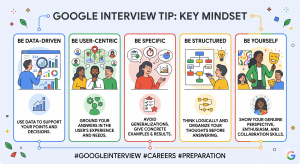
Google wants people who can think clearly, communicate well under pressure, handle ambiguity without freezing, and genuinely care about solving hard problems at scale. If you can show those things across your interviews, you are in a much stronger position than someone who memorised 200 algorithms but cannot explain their own thought process.
Keep that in mind as you read through each round below.
Round 1 — Your Resume and Application
Nobody talks enough about this stage. Most people treat the resume as a formality. It is not.
Your resume is the first impression Google gets of you — and it is usually reviewed in under 30 seconds. That sounds harsh, but it is just the reality of how many applications they receive.
Here is what I have noticed that actually works:
Stop describing what you did and start showing what you achieved. There is a big difference between “worked on a team to build new features” and “built 3 new product features that reduced user churn by 18% over 6 months.” The second one tells a story. The first one tells nothing.
Every bullet point on your resume should answer the question: so what? What changed because of what you did? What improved, what grew, what got faster, what got cheaper?
Referrals make a massive difference. This is not a secret — Google employees themselves talk about it openly. If you know anyone at Google, even loosely through LinkedIn, reach out. Do not immediately ask for a referral. Ask if they have 15 minutes to share what working there is like. Build a genuine connection first. The referral conversation becomes much more natural after that.
One more thing on resumes — match your language to the job description. Not by copying it word for word, but by making sure the skills and experiences they are asking for are clearly visible in your resume. Google uses ATS filters before a human ever sees your application.
Round 2 — The Recruiter Phone Screen
You get the call. A Google recruiter introduces themselves and wants to chat for about 20 to 30 minutes.
I know this feels like a warmup. It is not. Recruiters are experienced at filtering — and this conversation shapes how they advocate for you internally.
The main things they want to know are simple: Why Google? What have you done? Do you understand the role you applied for? And are your expectations reasonable?
The “why Google” question trips people up more than any coding problem. The wrong answer sounds like: “Because Google is an amazing company with great perks and a strong culture.” Every candidate says some version of that. It means nothing.
The right answer is specific. Maybe you have been using Google Cloud at work and genuinely want to work on the infrastructure behind it. Maybe you care deeply about how Search surfaces information and have thoughts on how it could be better. Maybe there is a specific team whose work you have been following. Whatever it is — make it real and make it yours.
Also, do not be afraid to ask questions during this call. Asking “what does the team look like right now and what is their biggest challenge this quarter?” shows you are already thinking like someone who wants to contribute — not just someone who wants a job.
Round 3 — Technical Phone Screen (Engineering Roles)
Now things get serious.
This is a 45 to 60 minute live coding interview. You will share your screen or use a shared document, and you will be given one or two coding problems to solve while talking through your thinking.
The most common mistake here? Diving straight into code without saying a word.
Google interviewers are explicitly trained to evaluate how you think — not just whether you arrive at the correct answer. A candidate who talks through a slightly inefficient solution clearly and methodically will often score higher than someone who silently writes perfect code.
Before you write a single line, ask clarifying questions. What are the edge cases? What is the expected input size? Should I optimise for time or space? Can the input be negative? These questions show maturity and prevent you from solving the wrong problem.
Then say out loud: “Let me start with a brute force approach so I have something working, and then I will look at how to optimise it.” This signals confidence and a structured approach. Interviewers like that.
On preparation — LeetCode is the most widely recommended platform and for good reason. Focus on Medium difficulty problems. That is where Google’s phone screen questions tend to live. Do not obsess over Hard problems at this stage — build consistency and speed on Mediums first.
Round 4 — The On-Site Interviews (4 to 5 Rounds)
This is the big one. It usually happens over one full day — now mostly virtual — with back to back 45-minute sessions with different interviewers.
Here is what each round typically looks like:
Coding Round 1 and 2
Two separate coding rounds with two different interviewers. Same format as the phone screen but the problems are harder and the follow-up questions are more demanding.
Once you solve a problem, the interviewer might say: “Now can you do it in O(n) instead of O(n log n)?” or “What if the input was a stream of data instead of a fixed array?” These follow-up questions test how deep your understanding actually goes.
Do not panic when follow-ups come. They are not a sign you did something wrong. They are just the next part of the evaluation. Take a breath, think out loud, and work through it the same way you did the original problem.
One thing I want to say directly: if you get genuinely stuck, say so. “I am not immediately seeing the path to an optimal solution — can I talk through what I know about the problem structure?” Interviewers can give hints. Asking for a hint thoughtfully is a much better signal than sitting in awkward silence for 10 minutes.
System Design Round (Mid to Senior Level)
If you have 3 or more years of experience, expect a system design round. You might be asked to design something like a URL shortener, a news feed, a ride-sharing system, or a video streaming platform.
What they are testing here is not whether you know every technical detail. It is whether you can think at scale, make reasonable trade-offs, and communicate a complex architecture clearly.
Always start by asking about scale. Are we building for 10,000 users or 100 million? The answer completely changes the design. Then sketch a high-level diagram before diving into any single component.
Talk about trade-offs as you go. “I would use a relational database here because we need strong consistency, but if writes become a bottleneck, we could move this component to Cassandra and accept eventual consistency.” That kind of thinking is exactly what Google wants to hear.
The System Design Primer on GitHub is one of the most genuinely useful free resources for this round. It covers load balancing, caching strategies, database choices, and real examples of how large systems are built. Read through it slowly — not as a cram session but as something you actually want to understand.
Googleyness and Leadership Round (Behavioural)
Every on-site has at least one behavioural round. Google calls the qualities they assess here “Googleyness” — and it includes things like intellectual humility, how you handle disagreement, how you behave when things are ambiguous, and whether you take ownership when something goes wrong.
These questions sound soft. They are not soft. Candidates bomb behavioural rounds at Google all the time because they come prepared with polished, rehearsed answers that sound hollow.
What actually works is specificity. When they ask about a time you failed, they want a real failure — not “we had a challenge but worked through it as a team.” They want to hear what went wrong, what your role in it was, what you felt in that moment, and what you would do differently.
Prepare 6 to 8 genuine stories from your career — real moments where something difficult happened. Write them down. Practise telling them in about 2 minutes each. The best stories can flex across multiple question types. A story about a project that went sideways can answer questions about failure, conflict, ambiguity, and leadership depending on which part you emphasise.
The STAR framework (Situation, Task, Action, Result) is a clean way to structure these answers. But do not sound like you are reading from a template. Practise until it sounds like you are just talking.
Round 5 — The Hiring Committee
This part surprises a lot of people when they first hear about it.
After your on-site, your interviewers each write a detailed scorecard — their notes on how you performed, what stood out, what gave them pause, and whether they would hire you. These scorecards are then reviewed by a Hiring Committee — a group of senior Google employees who were not your interviewers and have no personal connection to you.
The committee makes the final hire decision based on those scorecards. Not any single interviewer.
This is actually one of the fairest parts of the Google process. It removes the situation where one overly enthusiastic interviewer pushes through a weak candidate, or one overly critical interviewer blocks a strong one. The committee looks at the full picture.
What this means practically: do not assume that one great round saves you if the others were weak. Consistent performance across all rounds matters more than one standout session.
Round 6 — The Offer (and How to Negotiate It)
The recruiter calls with a verbal offer. Exciting moment — but do not say yes immediately.
Google’s compensation packages are genuinely strong. They typically include a base salary, an annual bonus, and RSUs (stock units) that vest over four years. The combination can be significantly higher than the base salary number suggests.
Here is something important: Google expects candidates to negotiate. The first offer is rarely the top of their range. Do not negotiate by just saying “can you do better?” Come in with a specific number and a reason. “Based on what I have seen in the market for this role and location, I was expecting something closer to X — is there any flexibility there?” That is a professional, reasonable way to have that conversation.
The Honest Summary
Google’s process is long. It takes 4 to 8 weeks from first interview to offer in most cases. It tests you across multiple dimensions — coding, design, communication, leadership, and culture fit — all at once.
But it is also one of the most transparent and structured hiring processes in the industry. You know what is coming. You can prepare for it. And the candidates who succeed are not always the most technically gifted — they are the ones who prepared the most thoroughly and showed up as full human beings, not just programmers.
If there is one thing I would tell anyone preparing for Google: practise explaining your thinking out loud. Do it every single day. That skill — communicating while you think — is what separates the candidates who get offers from the ones who do not.
Found this helpful? Share it with someone who is preparing for a big tech interview. And if you have questions about any specific round, drop them in the comments — I read every one.

